• Skip to primary navigation
  • Skip to main content
  • Skip to footer
OMA Comp

OMA Comp

Web Design & Development

  • Home
  • About
    • Our Culture
    • Client Testimonials
    • Photo Gallery
    • Video Testimonials
    • FAQ
  • Services
    • Web & Creative
      • Custom App Design
      • Drone Services
      • Graphic Design
      • Logo Design
      • Online Stores
      • Photography/Videography
      • Video Production
      • Web Design/Development
    • Digital Marketing
      • Advertising & Paid Search (PPC)
      • B2B Marketing
      • Content Marketing
      • Email Marketing
      • Press Releases & Public Relations
      • Social Media Management
    • SEO & Online Visibility
      • Local SEO
      • Reputation Management & Repair
      • Search Engine Optimization (SEO)
      • Website Compliance (ADA, WCAG)
    • Technology & IT Solutions
      • Cloud Solutions
      • Custom Integrations
      • IT Support & Maintenance
      • Network Setup & Security
      • Managed Hosting
    • Strategy & Consulting
      • Analytics & Reporting
      • Marketing Strategy Development
      • Training & Support
      • Website & Brand Review
      • Social Media Boot Camp Classes
      • Events
  • Portfolio
  • Blog
  • Contact
    • Careers
    • Internships
    • Review Us
  • Online Bill Pay
  • Request a Quote
  • 248-616-3057

Google Ads

Google AI Max for Search: What Small Businesses Need to Know

September 17, 2026

Table of Contents
  • What Is Google AI Max for Search?
    • Search-term matching
    • Text customization
    • Final URL expansion
  • Benefits of Google AI Max for Small Business
    • Access to additional relevant searches
    • More relevant messages
    • Less manual expansion
    • Improved insight and controls
  • Risks to Review Before Enabling AI Max
    • Poor conversion data
    • Uncontrolled landing pages
    • Generated text that needs review
    • Budget spent on weak intent
  • How to Prepare an AI Max Campaign
    • 1. Define the business goal
    • 2. Repair conversion tracking
    • 3. Improve landing pages
    • 4. Review brand and URL controls
    • 5. Establish a baseline
    • 6. Monitor lead quality
  • AI Max Is Not the Same as Performance Max
  • Questions to Ask Your Advertising Partner
  • Use Automation With Clear Oversight
Digital advertising team reviewing campaign strategy in a meeting

Google AI Max for small business advertisers adds AI-powered targeting and creative features to eligible Search campaigns. It can expand search-term matching, customize ad text, and send users to a more relevant landing page. However, it does not remove the need for accurate conversion tracking, strong offers, useful landing pages, and active campaign oversight.

Before enabling it, business owners should understand what changes, which controls remain available, and how to evaluate performance.

What Is Google AI Max for Search?

AI Max is a suite of optional enhancements for Search campaigns. According to Google Ads Help, it combines improved search-term matching, text customization, and final URL expansion.

Those features can help an advertiser respond to a wider range of relevant searches. They can also reduce the limits of a campaign built around a small, manually maintained keyword list.

Search-term matching

Search-term matching uses information from existing keywords, ads, landing pages, and other campaign signals. Its goal is to find relevant queries that the current keyword setup may miss.

This can be useful as people search with longer, more conversational phrases. However, a broader reach can also expose weak targeting. Advertisers still need to review search terms and exclude irrelevant themes.

Text customization

Text customization can generate or adapt headlines and descriptions using content from the website and other campaign assets. The feature aims to make the message more relevant to each search.

A clear website gives the system better source material. Pages with vague claims, outdated promotions, or inconsistent service information can lead to weaker assets.

Final URL expansion

Final URL expansion can select a landing page that appears more relevant than the URL initially chosen for the ad. For a company with detailed service pages, this may connect customers with a better answer.

Advertisers can use URL exclusions when certain pages should never receive paid traffic. Examples may include careers, privacy policies, outdated promotions, or support pages intended for existing customers.

Benefits of Google AI Max for Small Business

Access to additional relevant searches

Customers do not always use the keywords a business expects. AI Max may identify useful variations and longer questions without requiring a separate keyword for every phrase.

More relevant messages

When the website and campaign assets are strong, text customization may align the ad more closely with the user’s need. Better alignment can create a clearer path from search to landing page.

Less manual expansion

Small teams may not have time to build hundreds of keyword and ad combinations. Automation can reduce some of that work. The saved time should go toward strategy, creative review, landing pages, and lead quality.

Improved insight and controls

Google has continued adding reporting and brand controls to AI-powered campaigns. Review the exact options available in your account because availability can vary by campaign type, market, and rollout stage.

Risks to Review Before Enabling AI Max

Poor conversion data

Automation optimizes toward the signals it receives. If every form submission counts as a valuable lead, spam and low-quality inquiries may influence bidding. A campaign should distinguish meaningful actions from basic page engagement.

OMA Comp’s analytics and reporting services can help connect campaign activity with calls, forms, and qualified outcomes.

Uncontrolled landing pages

Final URL expansion can be helpful only when the eligible pages are current and conversion-ready. Audit the website before allowing broader page selection. Exclude pages that contain weak, irrelevant, or sensitive content.

Generated text that needs review

Automated assets can misunderstand nuance. Regulated industries require special care. Review legal claims, prices, guarantees, medical language, financial statements, and required disclaimers.

Budget spent on weak intent

Expanded matching may find new demand, but not every new query has equal value. Monitor search themes, geographic performance, lead quality, and cost per qualified lead.

How to Prepare an AI Max Campaign

1. Define the business goal

Choose a clear goal such as qualified calls, scheduled consultations, purchases, or completed applications. Avoid optimizing toward page views when the business needs revenue-producing actions.

2. Repair conversion tracking

Confirm that forms, calls, purchases, and other primary actions fire correctly. Remove duplicate tags. If possible, return qualified or closed-lead data from the CRM to Google Ads.

3. Improve landing pages

Every eligible page should explain the service, location, process, trust factors, and next step. It should also load quickly on mobile devices. OMA Comp’s web and creative services can strengthen that conversion path.

4. Review brand and URL controls

Set relevant brand inclusions or exclusions when available. Build a URL exclusion list. Confirm that automatically generated text cannot pull from outdated or inappropriate pages.

5. Establish a baseline

Record current spend, conversions, qualified leads, cost per lead, and conversion value. Use a meaningful comparison window. Do not judge the change after one quiet day or a single unusual lead.

6. Monitor lead quality

Compare platform conversions with actual sales outcomes. A lower cost per form can still hurt the business when the forms are irrelevant. Review calls and CRM stages with appropriate privacy controls.

AI Max Is Not the Same as Performance Max

AI Max enhances Search campaigns. Performance Max is a goal-based campaign type that can access inventory across Search, YouTube, Display, Discover, Gmail, and Maps. The two products use automation, but they have different structures and placements.

A business may use Search, Performance Max, or both. The right choice depends on goals, creative assets, data quality, budget, and the ability to measure results.

Questions to Ask Your Advertising Partner

  • Which AI Max features will be enabled?
  • How will irrelevant searches be excluded?
  • Which landing pages can the system select?
  • How are generated assets reviewed?
  • Which conversions guide bidding?
  • How will qualified leads be measured?
  • What baseline will be used to compare performance?

Use Automation With Clear Oversight

Google AI Max for small business campaigns can expand reach and improve relevance. Still, its results depend on the strategy and data behind it. Accurate tracking, useful pages, clear controls, and human review remain essential.

OMA Comp provides paid search and PPC management for Michigan businesses. Contact our team to review your campaigns and decide whether AI Max fits your goals.
Schedule a Consultation

Filed Under: News Tagged With: AI Max, Google Ads, Paid Search, PPC

Google Ads vs Facebook Ads: Which Delivers Better ROI

February 13, 2026

Table of Contents
  • What Is Google AI Max for Search?
    • Search-term matching
    • Text customization
    • Final URL expansion
  • Benefits of Google AI Max for Small Business
    • Access to additional relevant searches
    • More relevant messages
    • Less manual expansion
    • Improved insight and controls
  • Risks to Review Before Enabling AI Max
    • Poor conversion data
    • Uncontrolled landing pages
    • Generated text that needs review
    • Budget spent on weak intent
  • How to Prepare an AI Max Campaign
    • 1. Define the business goal
    • 2. Repair conversion tracking
    • 3. Improve landing pages
    • 4. Review brand and URL controls
    • 5. Establish a baseline
    • 6. Monitor lead quality
  • AI Max Is Not the Same as Performance Max
  • Questions to Ask Your Advertising Partner
  • Use Automation With Clear Oversight

Understanding the Difference Between Google Ads and Facebook Ads

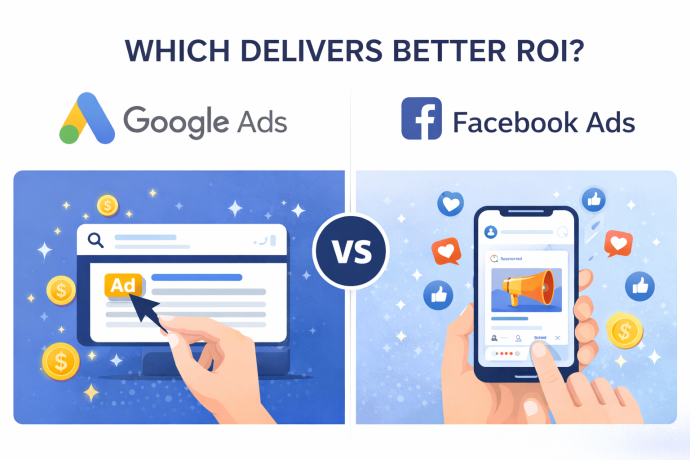
When businesses invest in paid advertising, one of the most common questions is whether Google Ads or Facebook Ads delivers better ROI. Both platforms offer powerful tools, but they work differently and serve different purposes within a marketing strategy. Google Ads focuses on search intent. Users actively search for products or services, making it a demand capture platform. Facebook Ads focuses on audience targeting and interest based advertising, making it more of a demand generation platform. Understanding this difference is essential when evaluating return on investment.

How Google Ads Generates ROI

Google Ads allows businesses to appear at the top of search results when users type in specific keywords. This means your ads reach people who are already looking for what you offer. Because of this high intent behavior, Google Ads often delivers strong conversion rates. If someone searches for services like digital marketing agency near me or website design services, they are closer to making a decision. However, competition can increase cost per click. Success depends on keyword strategy, optimized ad copy, strong landing pages, and effective bid management. When properly managed, Google Ads produces measurable and predictable results.

How Facebook Ads Generates ROI

Facebook Ads targets users based on demographics, interests, and online behavior. Users are not actively searching when they see your ad. Instead, your message appears based on audience targeting. This makes Facebook Ads ideal for brand awareness and audience building. It often delivers lower cost per click and flexible budgeting. However, conversions depend heavily on strong creative, compelling messaging, and retargeting strategies. Facebook Ads works best when nurturing potential customers over time.

Comparing Conversion Intent

The biggest difference between Google Ads and Facebook Ads is intent. Google Ads captures existing demand. Users search with purpose, which often leads to quicker conversions. Facebook Ads creates demand by introducing your brand to new audiences. This may result in longer buying cycles but stronger brand visibility. If your goal is immediate lead generation, Google Ads may provide faster ROI. If your goal is awareness and audience growth, Facebook Ads can be highly effective.

Cost and Budget Considerations

Google Ads often has higher cost per click due to competition. However, high intent traffic can justify the investment. Facebook Ads typically offers lower cost per click and allows businesses to test multiple audiences and creatives. The platform you choose should align with your marketing goals and budget strategy.

The Best Strategy: Integration

Many businesses see the strongest ROI when combining both platforms. Google Ads captures high intent traffic, while Facebook Ads nurtures and retargets users who have already interacted with your brand. An integrated strategy creates multiple touchpoints and increases conversion potential. Someone may discover your brand through Facebook, then later search for you on Google before converting.

Final Thoughts

There is no universal answer to which platform delivers better ROI. The best choice depends on your goals, industry, and audience. Businesses focused on immediate conversions often benefit from Google Ads. Companies seeking long term growth may prioritize Facebook Ads. In many cases, combining both platforms produces the most effective results and sustainable marketing performance.

Filed Under: Blogging Tagged With: digital marketing ROI, Facebook Ads, Google Ads, online marketing, paid advertising strategy, PPC advertising, social media advertising

How to Use Google Ads and Meta Ads Together for Maximum ROI

December 5, 2025

Table of Contents
  • What Is Google AI Max for Search?
    • Search-term matching
    • Text customization
    • Final URL expansion
  • Benefits of Google AI Max for Small Business
    • Access to additional relevant searches
    • More relevant messages
    • Less manual expansion
    • Improved insight and controls
  • Risks to Review Before Enabling AI Max
    • Poor conversion data
    • Uncontrolled landing pages
    • Generated text that needs review
    • Budget spent on weak intent
  • How to Prepare an AI Max Campaign
    • 1. Define the business goal
    • 2. Repair conversion tracking
    • 3. Improve landing pages
    • 4. Review brand and URL controls
    • 5. Establish a baseline
    • 6. Monitor lead quality
  • AI Max Is Not the Same as Performance Max
  • Questions to Ask Your Advertising Partner
  • Use Automation With Clear Oversight

Introduction

Paid advertising is one of the fastest ways to generate leads and revenue, but using a single platform limits your reach. Combining Google Ads and Meta Ads creates a powerful, multi-channel strategy that captures consumers across the entire buying journey. When executed correctly, running both platforms together significantly increases visibility, conversions, and overall return on investment.

Why Use Both Platforms

Google Ads targets high-intent searches, capturing users actively looking for products and services. Meta Ads, which include Facebook and Instagram, excel at demand generation, audience building, and retargeting. By pairing them, you reach prospects before they search and again when they are ready to buy.

Strengths of Google Ads

Google Ads are ideal for search-driven conversions. With strong keyword targeting, you position your business in front of active shoppers. Search, Display, and YouTube campaigns provide additional layers for brand awareness and lead generation.

Strengths of Meta Ads

Meta Ads offer unmatched demographic and interest-based targeting. They allow businesses to create compelling creative assets, boost brand recognition, and nurture cold audiences. Meta’s remarketing capabilities help re-engage visitors who interacted with your business but did not convert.

How to Combine Both for Maximum ROI

Start with Meta Ads to warm up audiences and build engagement. Follow up with Google Ads to capture high-intent traffic ready to convert. Use consistent messaging and track both platforms in a unified analytics dashboard. Cross-platform retargeting helps maintain visibility and reduces cost per acquisition.

A strong strategy also includes testing different formats such as Google Performance Max and Meta Advantage campaigns. Both provide automation benefits while expanding your reach.

Conclusion

Google Ads and Meta Ads are highly effective on their own, but together they form a complete, full-funnel advertising strategy. Businesses that leverage both platforms consistently see better lead quality, stronger conversions, and maximum ROI.

Filed Under: Blogging Tagged With: digital advertising, Facebook Ads, Google Ads, Instagram Ads, Meta Ads, multi-channel marketing, paid advertising strategy, PPC marketing, ROI optimization

Footer

Contact Information


OMA Comp

318 Woodlawn Avenue
Royal Oak, MI 48073-2615

Phone: 248-616-3057
Fax: 248-232-0075

Review Us | Request A Quote

Contact Us

Recent Posts

  • How Service-Area Businesses Can Improve Google Maps Visibility
  • Local Citations for Michigan Businesses: Which Directories Matter?
  • How to Respond to Fake or Unfair Google Reviews
  • Could the GTA VI Release Slow Down Your Internet?
  • How to Get More Google Reviews for Your Royal Oak Business

Newsletter Signup

Subscribe below to hear about our latest product offerings and promotions.

Subscribe

Connect With Us

  • Facebook
  • Instagram
  • LinkedIn
  • Twitter
  • YouTube
  • Phone: (248) 616-3057
  • Review Us
  • Newsletter Sign Up

Copyright © 2026 OMA Comp · Repair Policies · Terms and Conditions · Privacy Policy · Service Ticket

Accessibility Adjustments
How long do you want to hide the toolbar?
Hide Toolbar Duration
Select your accessibility profile
Vision Impaired Mode
Enhances website's visuals
Seizure Safe Profile
Clear flashes & reduces color
ADHD Friendly Mode
Focused browsing, distraction-free
Blindness Mode
Reduces distractions, improves focus
Epilepsy Safe Mode
Dims colors and stops blinking
Content Modules
Font Size

Default

Line Height

Default

Color Modules
Orientation Modules